Passive Income Trend: $1K → $2,377 (Live Drawdown Shown)
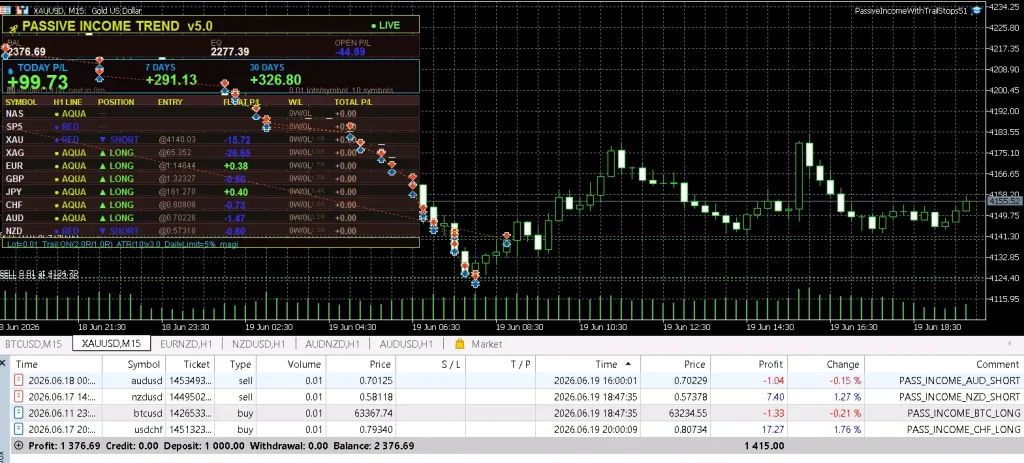
Today I’m showing you my own EA — Passive Income Trend — live on demo, and I’m showing it to you while it’s sitting in an open drawdown right now. The account is up from $1,000 to $2,377, but I’m not going to hide the −$92 of open positions currently in the red. That real-time honesty is the whole point.
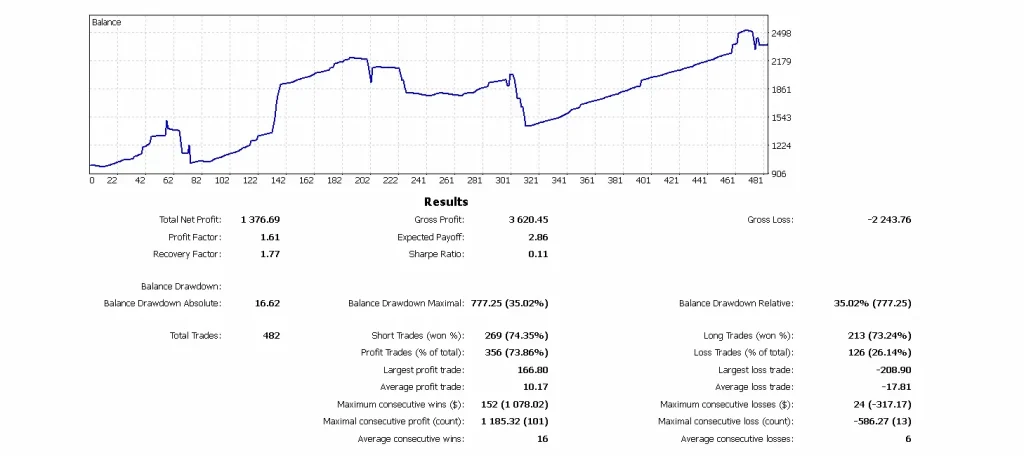
✅ Live snapshot, shown warts and all: Vantage demo account (MT5), grown from $1,000 to a $2,377 balance over the run. Right now equity is $2,277 — meaning about −$92 of floating loss on open trades as I write this. Demo, not real money: a forward-test, not proof it survives live. I’m posting the messy middle, not a tidy victory screenshot.
Passive Income Trend results: the real numbers
- $1,000 → $2,377 balance — about +137% over the account’s run
- Currently −$92 floating on open positions (equity $2,277) — yes, in drawdown right now
- One position carrying the basket: a gold (XAUUSD) short at +$102
- The rest: a spread of small open losers — silver, gold, GBP, CHF — that the EA is currently holding or managing
- Tiny position sizing (0.01 lots) — deliberately conservative exposure
Here’s why I’m comfortable showing the red: a snapshot of open trades will always catch some positions underwater — that’s normal trading, not failure. What matters is the account’s trajectory and how the EA behaves when a trend turns. And that’s the part I’m actually proud of.
How Passive Income Trend works
The EA follows trends carefully on the 4-hour timeframe — it’s not a blind grid that piles in regardless. The core logic that matters: when a trend breaks, it cuts the position. If you look back through the account’s history, you’ll see it has made some tough, responsible exits — closing trades at a loss rather than hoping, then recovering well afterward. That single behaviour — being willing to take a planned loss to protect the account — is the difference between an EA that compounds and one that blows up. The newer versions also add trailing stops and profit protectors to lock in gains as trends mature.
What I’m building next: a Sentinel equity protector
I’m now developing a separate Sentinel equity-protection EA — a layer that watches the whole account and can make even more disciplined decisions to protect equity in a genuinely hostile market. Because here’s the honest truth I’ve learned the hard way: the strategy that makes money and the safety system that stops you giving it all back are two different jobs. Most blown accounts happen because the second job was never built. I’m building it.
The honest verdict on Passive Income Trend
I’m genuinely excited about this one — not because it’s never in the red (it’s in the red right now, and I’m showing you), but because Passive Income Trend does the thing most EAs refuse to do: it cuts losing trends instead of averaging into oblivion, and the account has more than doubled while doing it. That said — it’s demo, the open basket is currently down, and no EA is proven until it survives a real account through a brutal market. I run a second account on crypto pairs too, and I’ll be posting those results here as well.
Good days and red days, live. That’s the deal on this site.
Important: Results shown are from a demo account, not live trading, and reflect open floating positions that can change minute to minute. Not financial advice. Trading forex and CFDs carries a high risk of loss — most retail traders lose money, and demo performance frequently fails to survive a real account. Past performance does not predict future results. These are my own results and opinions. Never trade money you can’t afford to lose.