RSI Mean Reversion 2: +6.6% on Demo, 4.25% Drawdown
Friday, 3 July 2026
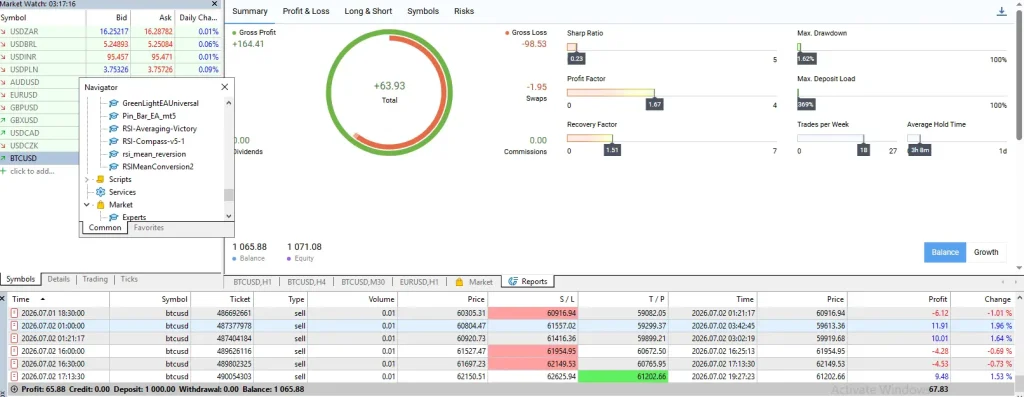
Today’s EA is RSI Mean Reversion 2 — a rebuild born from a string of earlier versions that kept losing money. After months of reworking the logic, the first impression is finally promising: +6.6% on demo with a small 4.25% drawdown. It’s far too early to call it stable, and I’ll explain exactly why — but for once the early data is worth sharing.
✅ Honest snapshot: VT Markets demo account (MT5). RSI Mean Reversion 2, my own EA, trading BTCUSD. Net profit +$65.88 ($1,000 → $1,065.88, about +6.6%) over roughly 10 days. Demo, not live. And a big caveat up front: 36 trades is a tiny sample, and we’re in the quiet summer season — so I genuinely don’t know yet how much these results will hold.
The numbers that matter: +$65.88 net, profit factor 1.67, and a maximum drawdown of just 4.25%. Small and controlled — that low drawdown is the real achievement, not the profit.
Old version vs RSI Mean Reversion 2: the honest before/after
This EA didn’t appear from nowhere — it’s the successor to earlier versions that lost money on the same strategy and the same pair. Here’s the real comparison, both sets of numbers from my own broker statements:
Metric
Old version
RSI Mean Reversion 2
Trades
3,853
36
Win rate
37.1%
50.0%
Profit factor
0.70 (losing)
1.67
Max drawdown
100% — blew the account
4.25%
Largest single loss
−$101.73
−$14.94
Net result
−$1,000 (account dead)
+$65.88 (+6.6%)
Both columns are from my own real statements, same strategy family, same instrument. The old version needed nearly 4,000 trades to destroy $1,000; the new one has made a small profit in 36 — the difference is risk control, not luck.
The point of showing you the dead account next to the living one isn’t to brag about the new version — it’s that this is what the learning actually costs. A blown account is the tuition. RSI Mean Reversion 2 is what I built with the lesson.
RSI Mean Reversion 2 results: the real numbers
+$65.88 net profit (+6.6%) over about 10 days on demo
Max drawdown just 4.25% ($43.70) — the number that matters most
Profit factor 1.67 — average win $9.13 vs average loss $5.47
50% win rate across 36 trades — and it still profits, because winners are bigger than losers
Every trade carries a real stop-loss — no grid, no averaging into disaster
Here’s the honest read: a 50% win rate sounds unremarkable until you see the risk/reward. Winning trades average nearly double the losing ones, so the EA makes money even winning only half the time. And it did it while never drawing down more than 4.25%. Small, controlled, boring — which is exactly what I want.
What’s new in RSI Mean Reversion 2
The earlier versions failed for a familiar reason: when a trade went against them, they’d try to “recover” by piling in — and eventually one bad run wiped the account. The whole redesign is built to kill that behaviour:
Every trade is independent, with its own stop-loss. No recovery grids, no martingale rescue trades. If a trade is wrong, it’s cut — full stop.
It fades extremes using RSI. It buys deeply oversold and sells overbought readings, aiming for the bounce back toward the mean.
A dynamic RSI exit. Some trades close not at a fixed target but when RSI normalises back through the middle — locking in the bounce early. That interplay between fixed stops and the RSI exit is where the edge seems to come from.
Small fixed risk per trade (~0.5%). Even a long losing streak can’t do serious damage.
The moment that actually mattered: the June 24 dip
The real test wasn’t the profit — it was a sharp BTCUSD drop on June 24. An old version would have opened a recovery grid and margin-called. Instead, RSI Mean Reversion 2 took six small losses in a row as price kept falling (about −$36 total), each one an independent, stopped-out trade — then, as the bounce came, caught it with a couple of winners and ended the sequence roughly flat. Six losses in a row, and the account barely noticed. That is the whole point of the redesign: survive the bad runs so the good ones can add up.
Honest verdict on RSI Mean Reversion 2
I’m cautiously encouraged — emphasis on cautiously. RSI Mean Reversion 2 has only 36 trades behind it, the profit factor could easily drift lower, and the real test is a prolonged trending market where RSI stays pinned at an extreme for days and produces long losing streaks. We’re also in the quiet summer season, which flatters mean-reversion strategies; volatile conditions could look very different. So this is a promising first impression, not a proven system — and it stays on demo for a long while yet. But after months of failures, an EA that makes a small profit without ever risking the account is real progress worth showing.
Important: Results shown are from a demo account, not live trading, over a small sample and a quiet market period. Not financial advice. Trading forex, crypto and CFDs carries a high risk of loss — most retail traders lose money, and demo performance frequently fails to survive a real account. Past performance does not predict future results. These are my own results and opinions. Never trade money you can’t afford to lose.