BTC ATM Machine: 3 Months From Idea to Earning (Honestly)
Back in April I started building a grid scalper for Bitcoin and gold. Three months and a lot of frustrating dead-ends later, the BTC ATM Machine is finally doing what I hoped — earning steadily on demo, small profits harvested day after day, a bit like an ATM in your own backyard. But I’m going to show you something most trading blogs never will: the real drawdown behind every one of those profits. Because this is a grid strategy, and grids don’t earn without risk.
✅ Read this first: Everything here is on demo and cent accounts across several brokers — not live real money yet. This is a grid strategy, and grids carry serious drawdown (you’ll see a real $2,679 floating drawdown below, on a day that ended up only +$364). I’m showing you the risk next to the reward on purpose — that honesty is the whole point.
The BTC ATM Machine: three months from idea to earning
I started this project in April. The goal was simple to say and hard to build: a grid scalper that trades BTCUSD and XAUUSD on the 1-minute chart, entering on stochastic signals and building a laddered basket that takes small profits ($5 per basket) over and over. When it works, those small wins stack up fast.
Three months later, the BTC ATM Machine is earning consistently on demo — but the road here was full of frustration: versions that should have been better and weren’t, bugs that hid for a week, market moves that erased good runs. I’ll walk you through the real story, including the mistakes, because that’s where the actual lessons are. And I’ll pair every profit with the drawdown it cost, because “ATM” is a seductive word and this is not free money.
How I can show you the drawdown at all: a monitoring tool I built
Quick note on how I’m able to show you the honest risk numbers below, because it matters. Alongside my trading EAs I run a separate tool I built — my Performance Dashboard — whose only job is to observe and log. It doesn’t trade. It records floating drawdown (equity including open trades) in 15-minute buckets, all day, across all my EAs, and stores the history.
Why build that? Because Myfxbook, FX Blue and MT4’s own reports all show you closed-trade drawdown or end-of-day equity — none of them show floating drawdown by time of day. None answer the question that actually matters for a grid: when does it put money at risk? On a recent Friday my dashboard showed the account quiet overnight, then risk concentrating in sharp windows: a spike at 03:00, then a cluster from 09:30 to 10:15, peaking at $409 of floating drawdown in a single 15-minute bucket during London/pre-New-York hours — on a day that ended up just +$38.74. That tool is a whole story of its own, and I’ll give it its own post soon. For today, it’s simply the honest lens I’m using to show you the ATM Machine’s real risk.
The earnings — shown next to the drawdown, always
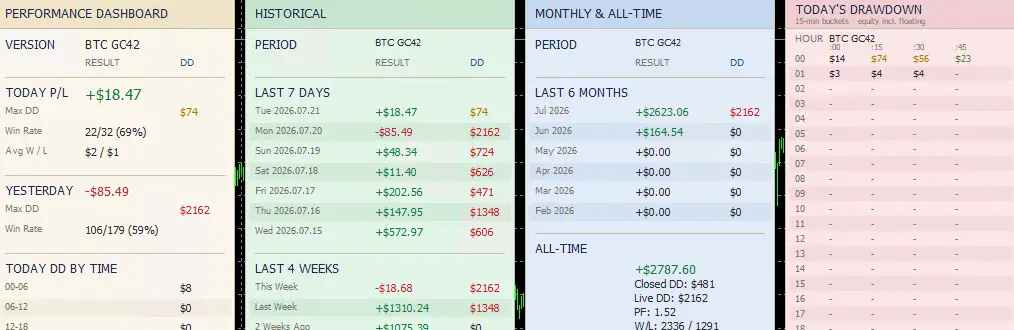
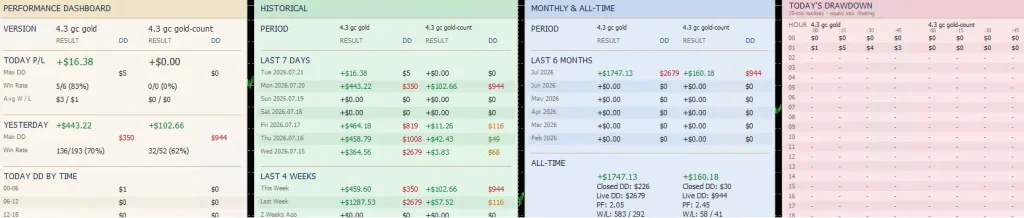
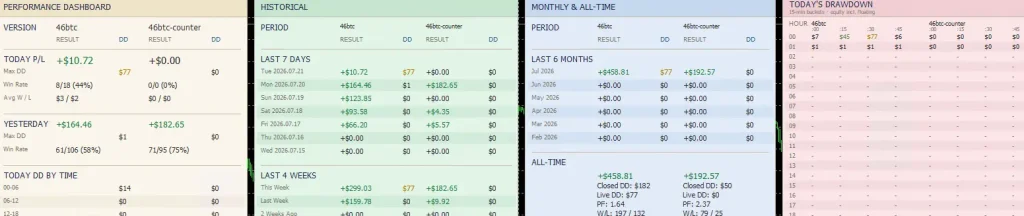
Here are real demo results, and I’m deliberately pairing every profit with the drawdown it cost:
| Account / market | Result | The drawdown behind it |
|---|---|---|
| Gold (XAUUSD), 3 days | +$1,056, profit factor 1.88 | Wednesday: +$364 earned against $2,679 floating drawdown |
| BTCUSD account A, all-time | +$2,224, profit factor 2.51 | Live floating drawdown reached $1,999 |
| BTCUSD account B, July | +$2,467 (June was just +$164) | Drawdown to $1,348; huge month-to-month variance |
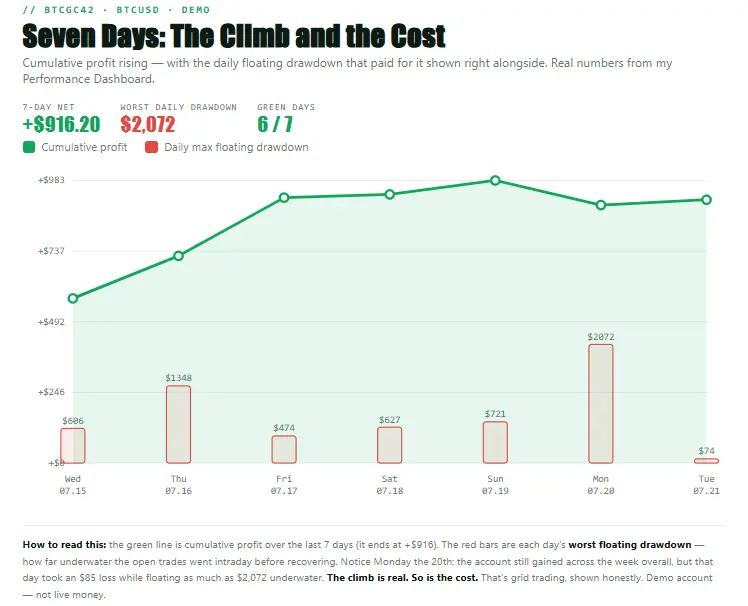
Real demo/cent dashboards. Notice the pattern: good profits, but drawdowns of $1,000–$2,700 are routine on days that end up only a few hundred dollars. That’s not a flaw I’m hiding — it’s the nature of grid trading, and it’s why this stays on demo and cent accounts.
That Wednesday gold number — +$364 earned while $2,679 floated underwater — is the single most honest figure in this post. A hype seller shows you the +$364. I show you the $2,679 it rode through to get there. That’s the real price of grid trading, and you deserve to see it.
The mystery: my “improved” EA earned less. Why?
Here’s the part that had me pulling my hair out, and it’s a lesson worth sharing. I built version 4.3 with a smart new protection layer and a low-CPU engine — genuinely better on paper. And it quietly earned less than the older 4.2, on the same market. That made no sense, so I did a forensic line-by-line comparison of the two versions. The culprit:
- A 5-second gate. Version 4.3 only checked for entries every 5 seconds. On 1-minute BTC and gold, stochastic signals appear and vanish within seconds — so 4.3 was literally missing trades 4.2 caught. The dashboards proved it: 44 trades vs 30 on the same day.
- Mixed bookkeeping. The new protection engine’s profits were being counted toward the daily target, which made the core engine stop trading earlier than it should have.
- A stale data cache on the daily-limit checks.
The lesson I keep relearning: “more sophisticated” is not the same as “better.” Sometimes your improvement is quietly costing you, and only the data — not your assumptions — will tell you the truth.
The quiet hero: the counter engine
There’s a second engine in this system that I’ve grown to love. It sleeps until the main grid is underwater by $200, then trades carefully in the opposite direction, harvesting small profits from the adverse move. Its absolute profits are tiny — but its profit factor is nearly 4.0, with a fraction of the drawdown of the main engine. It’s the disciplined, patient part of the system. So in the new version, I’m doubling its size to let it contribute more — because the data earned it that promotion.
What v4.6 does — and the honest limits
The new version, “ATM Machine Grid Commander Super,” merges the fast engine of 4.2 with the protection layer of 4.3, fixes all three bugs above, and adds attach-and-go AutoConfig for 9 markets. But here’s the disclosure I insist on:
- Only 2 of the 9 market profiles (BTCUSD and XAUUSD) are live-proven. The other 7 are volatility-scaled estimates, not yet tested. My own recommendation in the EA is to run any new pair on a cent account for a week first.
- Nothing in this EA force-closes a losing basket. The daily loss limit only pauses new trades. The real backstop is account equity — which is exactly why this belongs on cent accounts, where the big floating swings are survivable, and never on funded/prop accounts, where they’d breach equity limits instantly.
- Worst case is real: a full ladder plus a violent adverse move could float five figures underwater. This is a position-sizing question by design, and I won’t pretend otherwise.
The full v4.6 feature set
For those who want the technical detail, here’s what “ATM Machine Grid Commander Super v4.6” actually is:
- Dual engines. A core Fibonacci grid scalper (stochastic tape entry, up to 10 levels, $5 basket take-profit) plus an independent counter engine that arms at −$200 core floating loss and scalps the opposite direction, but only with signal agreement.
- Every-tick engine restored (the fix for the profit leak described above), with a timer heartbeat for quiet weekend crypto markets and a signal cache to keep CPU low — friendly to older hardware.
- Separate bookkeeping per engine. The core’s daily target/limit ($500 / $200) sees only the core; the counter is never blocked by the core’s daily limit.
- Counter engine starts at 0.02 lots with its own scaled Fibonacci ladder, max depth 6, and a margin-level guard.
- AutoConfig for 9 symbols — attach and go: BTCUSD and XAUUSD on live-proven values; ETHUSD, LTCUSD, SOLUSD, XRPUSD, XAGUSD, USOIL and US30 on estimated profiles that still need testing (run them on cent first).
- Percent-of-price grid distance on ETH and US30, so the spacing is broker- and price-level-proof rather than breaking on digit conventions.
- Unique magic numbers per symbol (881xx core, +1 for counter) and trade comments GC46 / GC46_CTR, for clean per-engine attribution.
- Broker sanity check at startup — it logs the real grid step for your broker’s digit setup and warns if something looks wrong (it catches the 4-vs-5-digit and 2-vs-3-digit differences that silently break grids across brokers).
- Dual-column live dashboard — session, tape, equity, a daily P/L progress bar, basket/grid status, entry readiness, plus the counter engine state and today/week/all-time closed stats per engine. (This is the trading EA’s own status display; the 15-minute floating-drawdown tracking comes from my separate Performance Dashboard tool.)
- Recommended-use guidance built in (About tab and inputs header): M1 only, and a clear marking of which pairs are proven versus which are still test profiles.
- Trades 24/7 wherever the market is open — no forced closes, no trade-reduction logic. And I want to be blunt about the flip side of that: because nothing force-closes, risk is managed entirely by position sizing on cent accounts, not by the EA bailing you out. That’s a deliberate design choice, and it only works if the account is sized for the drawdowns you’ve seen above.
The verification process, caught working (a real example)
Remember how I said 7 of the 9 profiles are estimates and you should test them first? Here’s that exact process catching something, live, within hours of deploying ETHUSD. The trade-log timestamps showed the grid adding a new ladder rung every 60 seconds — far too fast. The math showed why: ETH’s grid step was mis-scaled, so tiny price “breathing” was triggering adds that should only happen on a real adverse move. I caught it in the live trade log, fixed the scaling the same day (the step now requires ETH to genuinely move against the basket, not just drift), and re-deployed.
That’s the whole difference between an “estimated” profile and a “proven” one — and now you’ve watched the verification actually work. The tight, high-frequency trading you want stays intact; the ladder just won’t sprint to full depth on gentle drift anymore. This is what building in the open looks like: not perfect code shipped flawlessly, but real trades exposing a flaw and an honest, fast fix.
Why I’m telling you all this on a slow blogging week
Honestly? I haven’t posted much lately because I’ve been buried in this work — and not every day of it feels like progress. Some days are pure frustration and doubt: a change that should help earns less, a bug hides for a week, a market move erases a good run. That’s the real texture of building something. But I’m still here, every day, with a clear plan: build EAs and trading systems that can genuinely produce passive income — tested honestly, for months, before a cent of serious money goes near them.
The BTC ATM Machine isn’t finished. It’s promising, it’s earning on demo, and it carries real risk I can now measure to the quarter-hour. That’s not an ATM yet. But it’s real progress, built in the open — drawdowns and all. And I’ll keep showing you every step, the good days and the frustrating ones.
+$364 earned while $2,679 floated underwater.the most honest number in this post
<p class="honest-quote">+$364 earned while $2,679 floated underwater.<span>the most honest number in this post</span></p>Important: All results shown are from demo and cent accounts, not live real-money trading. Not financial advice. Grid and martingale-style strategies carry a very high risk of large or total account loss — the $1,000–$2,700 drawdowns shown here are real and routine, and worst-case losses can be far larger. Past and demo results do not predict future outcomes. These are my own results and opinions. Never trade money you can’t afford to lose.