The Day My Trading Robot Made $20,000
Some days the robot just quietly ticks along. And then there are days like this one — where I looked at the screen, did a double-take, and looked again: the BTC ATM Machine had pulled in over +$20,000 in a single day. On a demo, yes — but a real, honest demo I’ve been running hard for two months. Here’s the story of the big day, why it happened, and the one account detail that turned out to matter more than I expected.
✅ Straight up: this is a RoboForex Pro demo account, not real money (yet). It’s a grid robot, so it rides big swings — the kind of thing that makes a +$20k day possible also makes scary days possible. I run two of my own safety tools on it (Series Guard and the Account Protector) to keep it honest. More on all that below — including the risk, because I’m not going to pretend it isn’t there.
The day the ATM actually spat out cash
I named this robot the “BTC ATM Machine” as a bit of a joke — the dream of a machine in your backyard that just hands you money. Most days it’s nowhere near that dramatic. But this day, it earned the name. +$20,133 banked in one day, with the account sitting at about $149,000. You can see it right there on the robot’s own dashboard — “Core today +20,133,” daily target smashed, and the robot politely pausing itself because it had already done its job for the day.
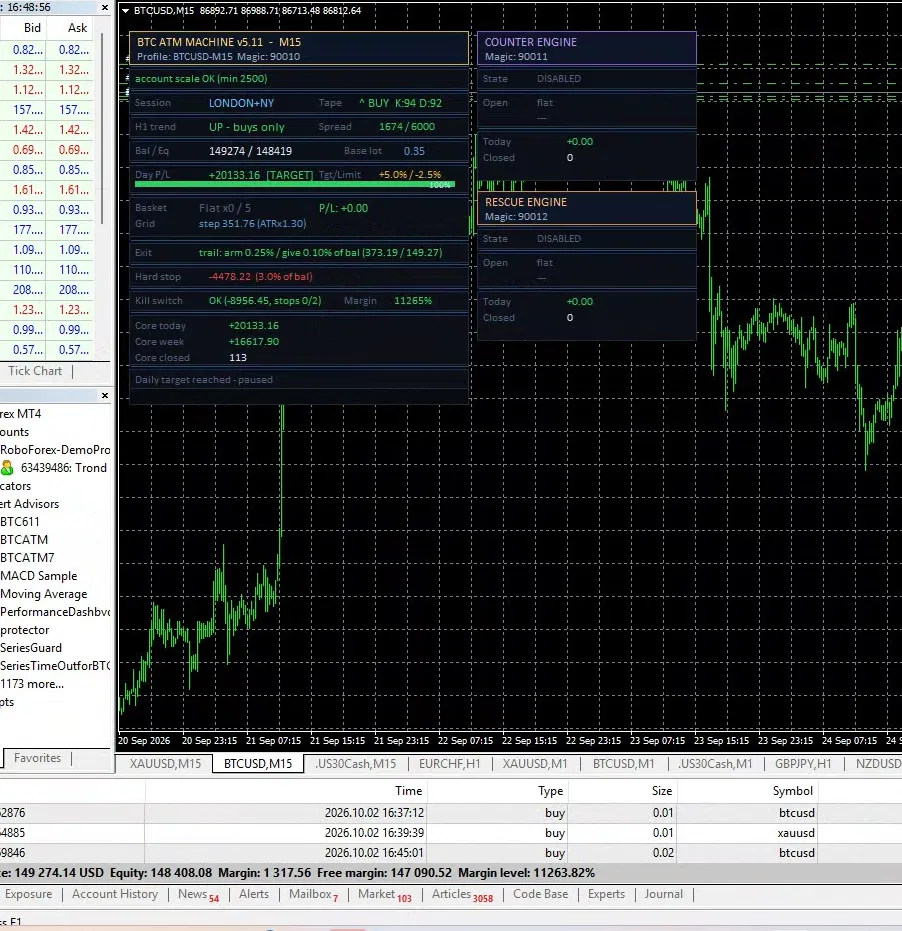
And here’s the honest, slightly emotional part. For a few weeks before this, the account barely moved. It drifted sideways, nickel-and-diming along, and I’ll admit it — I had doubts. You stare at a flat line for weeks and start wondering if the good run is over, if you’ve broken something, if it’s just done. Then a day like this shows up and reminds you: this robot works in bursts. Quiet stretches, then it catches a move and goes to work. The flat weeks weren’t it dying — they were it waiting.
The two-month scoreboard (the real numbers)
One big day is fun, but the bigger picture is what actually matters. This account started at $100,000 and it’s now sitting around $149,280 — up roughly $49,000 overall. Here’s the honest statement for the recent stretch, warts and all:
- Started at $100,000, now at about $149,280 — roughly +$49,000 over the full run (the broker only keeps recent demo history, so the detailed statement below covers the last stretch and shows +$43,799 of it)
- Profit factor 1.61 — it made $1.61 for every $1 it lost
- Max drawdown just 7.27% — the worst dip along the way, which for a grid is genuinely tidy
- 9,064 trades, winning about 69% of them
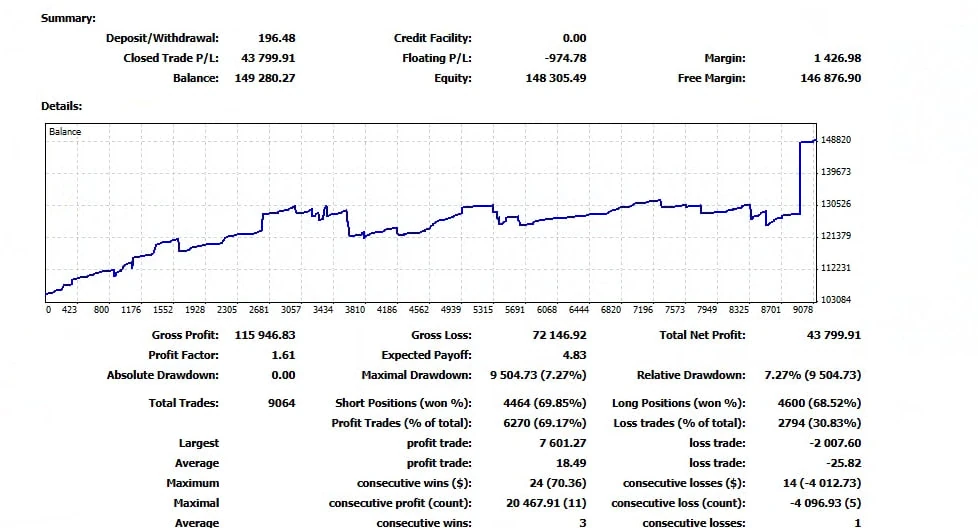
That equity curve tells the whole story in one picture: it climbs, it rests, it dips a little, it climbs again — and then that near-vertical line at the end is the big day. No straight-line-to-the-moon fantasy. Real ups and downs, trending up.
The surprise finding: the account TYPE matters, not just the broker
Here’s the bit I genuinely didn’t expect, and it’s worth more to you than the +$20k. I run a similar setup on two RoboForex demos: this one is a Pro account, the other is a regular demo. Same broker. Same robot. And the results are nowhere near the same — the Pro account grows like this, while the regular one grinds along with more losses and far less to show for it.
Why it matters so much for a grid: a Pro-type account usually means tighter spreads and better fills. My robot opens thousands of trades — over 9,000 in two months. When you trade that often, even a tiny difference in the spread on every single trade adds up to a massive difference at the end. On a grid that scalps constantly, the account type isn’t a small detail — it can be the difference between winning and losing.
So if you ever run something that trades a lot, don’t just pick a broker — look hard at the account type too. Same broker, different account, completely different outcome. That one lesson could save someone a lot of frustration.
How the robot actually works (the quick version)
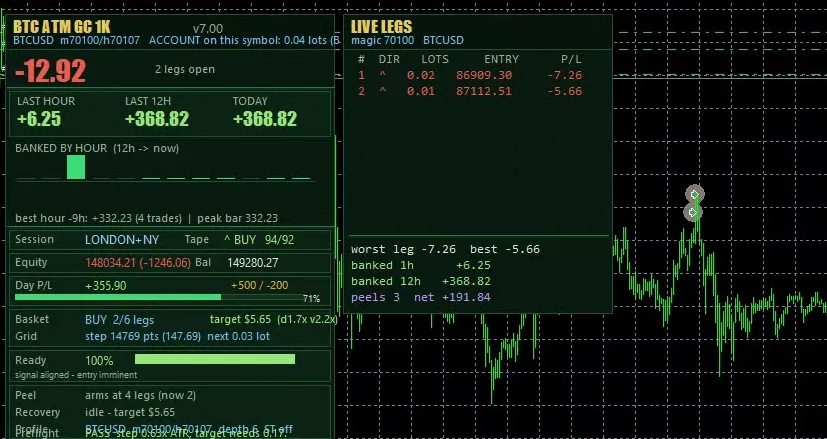
The BTC ATM Machine trades Bitcoin, gold and the US30 index with a grid approach — it ladders into positions and banks small wins over and over, with a daily target it aims for and then stops. You can see its live “legs” in the panel below: each open trade, its size, and its running profit or loss, all in one glance.
📘 New here? What’s “grid trading”?
A grid robot doesn’t guess which way the market’s going. When a trade goes against it, it opens another at a better price, building a “ladder” so the market only has to bounce back a little for the whole batch to profit. It works a treat when price bounces around — and it’s dangerous when price trends one way and doesn’t come back. That’s the trade-off, and it’s exactly why I run safety tools on top of it (see below).
The guardrails: why I sleep at night
Now the honest part, because a +$20k day with no mention of risk would be exactly the kind of hype I can’t stand. This robot rides big swings. On this very account I’ve seen a single trade lose two grand, and a run of 14 losers in a row. That’s the nature of the beast — the same engine that makes the huge days possible can have ugly ones.
That’s why I don’t run it naked. I built and run two of my own safety tools on this account:
- Series Guard — keeps an eye on the baskets and steps in on runaway series.
- Account Protector — watches the whole account’s floating risk and is ready to cut things off before a bad moment becomes a disaster.
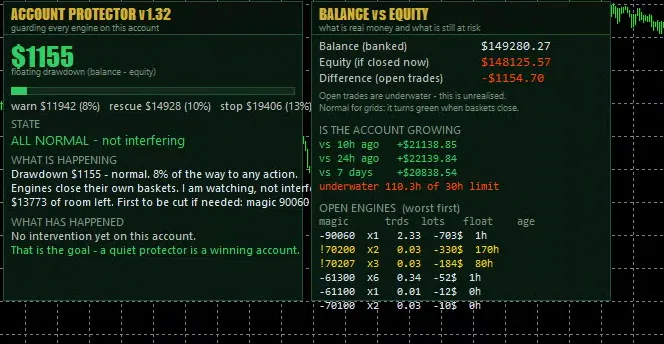
These aren’t magic — a grid can still have a rough day — but they turn “hope nothing goes wrong” into “something’s actually watching the risk.” That’s the difference between gambling and running a system.
So… am I going live?
Here’s where my head’s at, honestly. Two months, +$43k, a tidy 7% worst drawdown, real safety tools on top, and now a monster day proving it can still catch big moves — that’s starting to look like something I’d actually trust with real money. Not my life savings. But a cent account, funded with maybe $200–$500 (shown as 20,000–50,000 cents), where the swings are survivable and I can watch it do its thing for real? That’s genuinely on the table if this keeps up.
I’m not rushing it. The robot has to keep proving itself, and the account type lesson means I’ll be picky about where I run it. But for the first time in a while, I’m not just hoping — I’m looking at real numbers and thinking “yeah, this one might be a keeper.” And I’ll show you every step, the big days and the ugly ones, right here.
Important: All results shown are from a demo account, not live real-money trading. Demo results don’t reflect real execution, slippage or liquidity, and grid strategies carry a very high risk of large or total loss. A great day doesn’t guarantee the next one. Past and demo performance doesn’t predict future results. Nothing here is financial advice. Never trade money you can’t afford to lose.