How to Start Trading Forex (Without Losing Your Shirt in Week One)
So you want to start trading forex. Maybe you saw someone on YouTube in front of a rented Lamborghini. Maybe you just want a bit of side income that doesn’t involve driving for Uber at midnight. Either way — here’s the honest, no-nonsense guide to what you actually need to start, from a bloke who’s made every mistake so you don’t have to. And I mean every mistake. I’ve blown more accounts than I’ve had proper holidays.
✅ Straight up before we start: trading is genuinely hard and most people who try it lose money. I’m not here to sell you a dream — I’m here to show you the real starting line so you don’t trip over it like I did. Read this, take your time, and start with money you’d be okay setting on fire. Because sometimes that’s what it feels like.
What you actually need (it’s less than you think)
Good news: you don’t need a trading floor, six monitors, or a bloke in a headset shouting “buy, buy, buy!” Here’s the honest shopping list.
1. A computer (nothing fancy)
Any halfway-modern laptop or desktop will do. You’re not mining Bitcoin or editing Hollywood films — you’re running a trading platform, which is lighter than it looks. I run mine on gear that’s older than some of my EAs, and it copes fine. If your computer can handle a browser with too many tabs open, it can handle this. A phone can run the apps too, but for actually setting things up, a proper computer makes life easier.
2. MetaTrader 4 or 5 (the free platform)
This is the actual software you trade in — where you see the charts, place trades, and run robots (EAs). It’s free. The eternal question: MT4 or MT5?
- MT4 is the older one. Still hugely popular, tons of robots and tools built for it, rock solid. If you’re mostly into forex and using other people’s EAs, MT4 is perfectly fine.
- MT5 is newer, a bit faster, handles more markets (stocks, more crypto), and it’s where things are slowly heading.
Honest answer: for a beginner it barely matters — pick whichever one your broker pushes you toward, and don’t lose sleep over it. I use both, depending on the robot. It’s a bit like arguing Holden vs Ford; people have strong opinions, but both’ll get you to the shops.
📘 What’s an “EA” or trading robot?
An EA (Expert Advisor) is a small program that runs inside MetaTrader and trades for you automatically, based on rules. You don’t have to babysit charts — the robot does it. The catch: a robot only does what it’s told, so a dodgy one loses money just as happily as a good one makes it. Sorting the good from the dodgy is what most of this site is about.
3. A broker account (this is the important one)
A broker is the company that actually connects you to the market — you open an account with them, put your money in, and trade through their platform. This is the choice that matters most, so don’t just grab the first flashy one with the biggest bonus banner.
What to look for in a broker:
- Properly regulated. This is non-negotiable. A regulated broker is one a financial authority keeps an eye on, so your money isn’t just vanishing into someone’s back pocket in a country you can’t spell.
- Low spreads and fair fees. The spread is the little cut they take on every trade (there’s a fact box on that below). Lower is better, especially if you trade often.
- Offers a cent account. Huge for beginners — it lets you trade with real but tiny money while you learn, so a mistake costs you a coffee, not a car.
- Lets you run EAs. Most do, but check, if you’re planning to use robots.
💬 Honest heads-up about broker links: when I recommend brokers on this site, some of those links are affiliate links — meaning if you sign up through them, I may earn a commission, at no extra cost to you. I’m telling you that flat out, because the whole point of this place is honesty. I’ll only ever point you toward brokers I’d actually use myself, and the commission never changes what I tell you about them. If that’s not your cup of tea, no worries — you can always go to any broker directly.
Start on demo. Seriously. Do not skip this.
Every broker gives you a free demo account — a practice account with fake money on real live prices. Use it. This is where you learn which buttons do what without setting fire to your actual savings.
I know, I know — demo money is boring, it’s not “real,” you want to get in and make actual dollars. That impatience? That’s the exact feeling that’s emptied a thousand accounts, mine included. The market’s been there for decades and it’ll still be there next month. Learn on fake money first. Your future self will buy you a beer for it.
📘 What’s a “cent account”?
A cent account is a real account where your balance shows in cents instead of dollars — so $10 shows as 1,000 cents, and everything’s 100 times smaller. It means you can trade real (but tiny) money once you’re past demo, so the losses that would wipe a normal small account are survivable. For beginners and for risky strategies, it’s the sensible bridge between “fake money” and “oh no, that was rent.”
The honest order to do this in
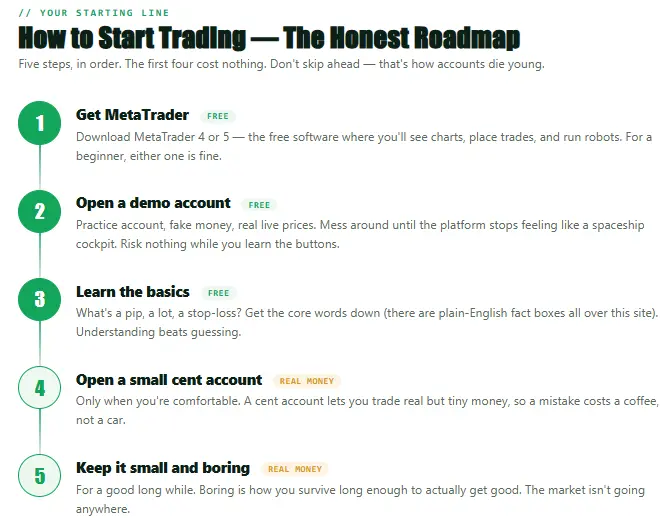
- Download MetaTrader (4 or 5) — free.
- Open a demo account with a regulated broker and mess around until the platform stops feeling like a spaceship cockpit.
- Learn the basics — what a pip is, what a lot is, how a stop-loss works (fact boxes all over this site).
- Only when you’re comfortable, open a small cent account with real money you won’t miss.
- Keep it small and boring for a good while. Boring is how you survive long enough to get good.
That’s it. That’s the whole starting line. Notice what’s not on the list: no expensive course, no “mentor” in your DMs, no signal group charging you $99 a month, no magic robot that definitely-for-sure prints money. If someone’s selling you that, keep your wallet in your pocket and slowly back away.
Where I fit into all this
I’m not a guru and I’m not going to pretend I’ve cracked it — I’m a bloke who builds trading robots, most of which have let me down in creative and expensive ways, and I write about it honestly so you can learn from my scars instead of collecting your own. Every week (or whenever I’ve got something worth saying) I post real results — the good, the ugly, and the “well, that was a dumb idea” — and explain what I’m learning in plain English.
Stick around, start on demo, keep it small, and don’t trust anyone waving a Lamborghini at you — including me, and I don’t even have one. Yet. (I’m kidding. Probably never.)
Not financial advice — just one bloke’s honest experience and opinions. Trading forex, CFDs and crypto carries a high risk of loss, and most retail traders lose money. Some broker links on this site are affiliate links that may earn me a commission at no extra cost to you. Never trade money you can’t afford to lose.