McQuack Scalper 2.5: Small Profits, Tiny 1.55% Drawdown
Wednesday, 1 July 2026
After testing and failing with version after version, I finally have something worth showing: McQuack Scalper 2.5 has put together about a month of small, stable profits on demo. I’m not here to brag — I’m here to be honest that this came after a long, grinding process of building and breaking dozens of EAs. This is what slow progress actually looks like.
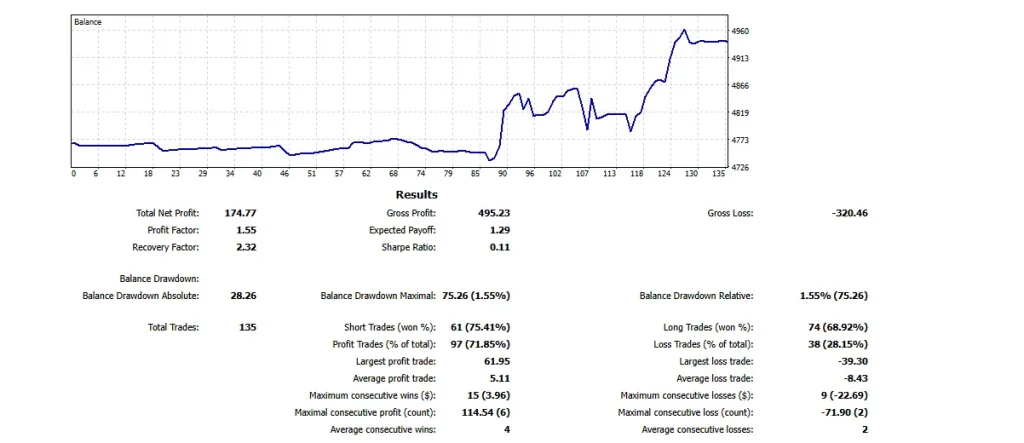
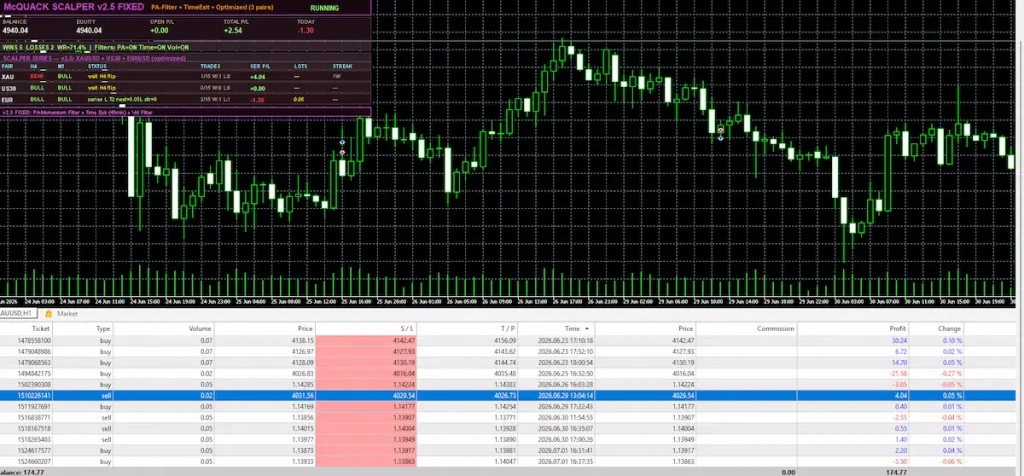
✅ Honest snapshot: RoboForex demo account (MT5). McQuack Scalper 2.5, my own EA, trading three instruments (DJ30, XAUUSD, EURUSD) off the 4-hour timeframe. Net profit +$174.77 — small, deliberately so. Demo, not live: this is a forward-test in progress, not a finished product. The point isn’t the size of the gain; it’s that it’s finally stable.
The numbers that matter: +$174 net, but with a maximum drawdown of just 1.55%. Small, controlled, and honest — that low drawdown is the real achievement here!
McQuack Scalper 2.5 results: the real numbers
+$174.77 net profit over the test period (about +3.5% on the account)
Maximum drawdown just 1.55% — this is the number I’m actually proud of
Profit factor 1.55, 72% win rate across 135 trades
Every trade carries a real stop-loss — no naked positions, no averaging into disaster
Trades three instruments off the 4H to pick higher-quality setups
That 1.55% max drawdown is the whole story. Anyone can post a profit; the question is how much risk it took to get there. An EA that grinds out a small, steady gain while never dropping more than 1.55% is behaving. After the wreckage of earlier versions, that controlled behaviour is what I’ve been chasing all along.
It’s not perfect — and I won’t pretend it is
McQuack Scalper 2.5 has closed plenty of trades at a loss. It doesn’t win every setup, and a month of stability on demo is not proof it will hold up live or through a genuinely hostile market. The security settings baked into the defaults — stop-losses on every trade, controlled sizing, the 4H filter — are there precisely because earlier versions taught me what happens without them. This is a work in progress, not a finished, proven system.
The honest part: this is a grind, and it’s hard
Here’s why I haven’t posted as often lately. Behind this one modest result from McQuack Scalper 2.5 sits a mountain of work you don’t see: I’m testing and improving more than twenty different EAs across different account types, timeframes, and instruments. Most days there’s no visible progress. Some days it’s ten steps back and zero forward — a set of changes that looked promising, tested, and failed. It’s mentally exhausting and, honestly, frustrating.
But that’s the actual job: work hard, test relentlessly, and improve the EAs until — maybe — they become genuinely profitable. I’m fully aware this could take many more months. The markets are never the same twice, which is exactly why these have to run on demo for a long time before I’d ever consider going live. There are no shortcuts here, and anyone who tells you otherwise is selling something.
McQuack Scalper 2.5 in action — recent trades adding up to +$174 net on the demo account. You can see the winners and the losers together; nothing cherry-picked!
Honest verdict on McQuack Scalper 2.5
This is a small win in a long campaign — and I’m genuinely encouraged, not because the profit is big (it isn’t), but because the risk is finally under control. One month of 1.55%-drawdown stability on demo is a hypothesis worth continuing to test, nothing more. I’ll keep running it, keep breaking and rebuilding the others, and keep posting the real progress here — including the frustrating, no-progress stretches. That’s the honest version of building trading systems, and it’s the only version I’m willing to show you.
Important: Results shown are from a demo account, not live trading. Not financial advice. Trading forex and CFDs carries a high risk of loss — most retail traders lose money, and demo performance frequently fails to survive a real account. Past performance does not predict future results. These are my own results and opinions. Never trade money you can’t afford to lose.
If you want to read more from the same grinding process: