My Pin Bar EA Tripled a Cent Account — Honest Results, Real Drawdown
Today I’m sharing an EA I’ve run for a long time — Pin Bar EA — paired with a small self-made tool that closes each pair’s trade series after a set number of hours. On the master account it’s roughly tripled a cent account in about a month — and this past week alone added about +$1,000. Here’s the honest breakdown, including exactly why that fast growth is a risk flag as much as a win.
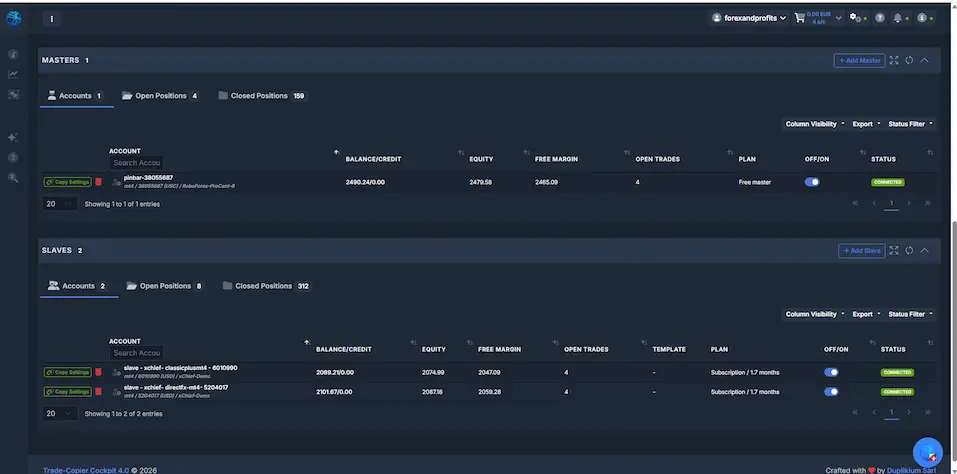
✅ Verified, and read this first: These results are from a RoboForex cent account — real money, but small (cent accounts use tiny position sizes, so this sits closer to a live forward-test than full-scale trading). The master grew from about $8 to roughly $24 (800 → 2,400 cents) between ~18 May and mid-June — about four weeks. I’m also copying it to two demo accounts via Duplikium, each up from $1,000 to nearly $2,000 since I started copying. The numbers are real; the scale is small. I’ll never pretend a cent/demo result is the same as trading serious capital live.
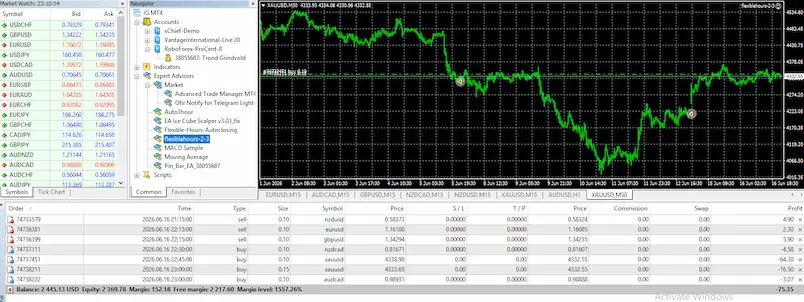
Pin Bar EA results: the real numbers
- Closed profit: +$1,002.62 over the period (8–16 June)
- Profit factor: 1.46 — gross profit $3,173 vs gross loss $2,171
- 415 trades, 53.5% win rate (222 wins / 193 losses)
- Average win +$14.30, average loss −$11.25 — a small, steady edge
- Max drawdown: 11.65% (−$218 at the worst point)
That profit factor of 1.46 is the number I actually care about — it means for every $1 lost, about $1.46 was made. These Pin Bar EA results aren’t a fantasy multiplier; they’re a real, repeatable edge on this account.
How the Pin Bar EA strategy works
Pin Bar EA trades pin-bar setups across several pairs (mostly XAUUSD, EURUSD, GBPUSD, NZD and AUD crosses). Alongside it, my own Flexible Hours Closing EA closes each pair’s trade series after a set number of hours — a simple time-based exit so positions don’t run indefinitely. It’s not magic: some weeks are flat or down. Most weeks, the combination nets a decent result.
Now the honest risk — what’s NOT pretty
- I’m carrying a −$94 floating loss right now on open trades — including an open gold position about −$95 underwater. Closed profit looks clean; the open book has red in it as I write this.
- It’s a cent account. Small real money. Behaviour at full position size, with real spreads and slippage on bigger lots, can differ a lot.
- The strategy averages into series (you can see the 0.15 and 0.23 lot adds in the history). That boosts winners — but averaging into a losing run is also exactly how accounts blow up. This is the part I watch most closely.
- The demo copies (Duplikium → two demo accounts) grew fast this week, but they’re demo. Fast demo growth proves the copying works, not that the edge survives real money at scale.
Honest verdict on these Pin Bar EA results
Tripling a cent account in a month looks exciting — and I want to be the one who tells you why that speed is itself a warning, not just a brag. Growth this fast almost always comes from a strategy that averages into positions and runs relatively aggressive sizing for the account. That’s the same mechanic that produces the fast gains and the fast wipeouts. The profit factor (1.46) and drawdown (11.65%) this week are healthy — but a four-week tripling is not a rate anyone should expect to continue, and I don’t.
So I’m enthusiastic but clear-eyed: I keep this on small/cent and demo sizing precisely because if the trend turns against the averaging, the drawdown can get ugly fast. If I ever scale it with real money, I fully expect losing weeks, and I accept it could draw down hard or blow at some point. That’s not pessimism — it’s the risk math being honest.
I’ll keep posting this one’s results here — the good weeks and the bad ones.
Important: Results shown are from a small cent account and demo copies, not large-scale live trading. Not financial advice. Trading forex and CFDs carries a high risk of loss — most retail traders lose money, and strategies that average into positions can lose rapidly. Past performance does not predict future results. These are my own results and opinions. Never trade money you can’t afford to lose.
Want the deeper story on grid risk?
- The forensic breakdown of 10,328 trades — how grid EAs blow up, and how I try to survive it.
- What 3,456 trades taught me about grid EAs — the same risk maths behind why I keep small accounts on cent brokers.