The 100% Win Rate That Blows Accounts
If someone shows you a trading system with a 100% win rate, they aren’t showing you a good strategy — they’re showing you a strategy that hasn’t closed its losses yet. I ran a controlled replay to prove it, and the result is the clearest risk lesson I can give you: a perfect, unbroken 100% win rate that would blow a real account. Here’s exactly how the trick works, and why it’s the most dangerous number in trading.
✅ Read this first: The numbers below come from a historical replay on XAUUSD H4 — a controlled test, not live trading, with no spread, swap or slippage modelled. That’s deliberate: I wanted to isolate the exit logic and show what “never close a loser” does even under perfect conditions. Nothing here is a signal, a product, or advice. It’s a lesson paid for with blown accounts — mine.
The number that should scare you: 100% win rate
A 100% win rate feels like the holy grail. Every trade closes green. The equity curve only goes up. It’s exactly what gets screenshotted and sold. But here’s the mechanical truth almost nobody explains: you can manufacture a 100% win rate on almost any strategy — simply by never closing a losing trade.
A trade is only a “loss” when you close it at a loss. So if your rule is “hold every losing position until it comes back to profit,” then by definition every trade that ever closes, closes green. 100% win rate. The losses don’t disappear — they just sit open, floating, underwater, uncounted. Until one of them doesn’t come back, and takes the whole account with it.
The proof: three exit rules, same trades, wildly different outcomes
To show this concretely, I took the same setup on gold (XAUUSD H4, a 6,000-bar replay) and ran it three ways — changing only how losing trades are handled. Everything else identical. Look at what happens:
Read that carefully, because it’s the entire lesson:
- Close the loser after 2 bars (bounded risk): 40.1% win rate, −$3,520. Looks bad — an ugly win rate and a real loss.
- Hold the loser to the trend end (bounded risk): 66.7% win rate, −$7,437. Better win rate, bigger loss.
- Hold the loser until profitable (unbounded risk): 100% win rate, +$24,355. Perfect record. Big profit. The dream.
If I stopped there, the third row is the one I’d sell you. 100% win rate, +$24,355, on gold. Who wouldn’t want that?
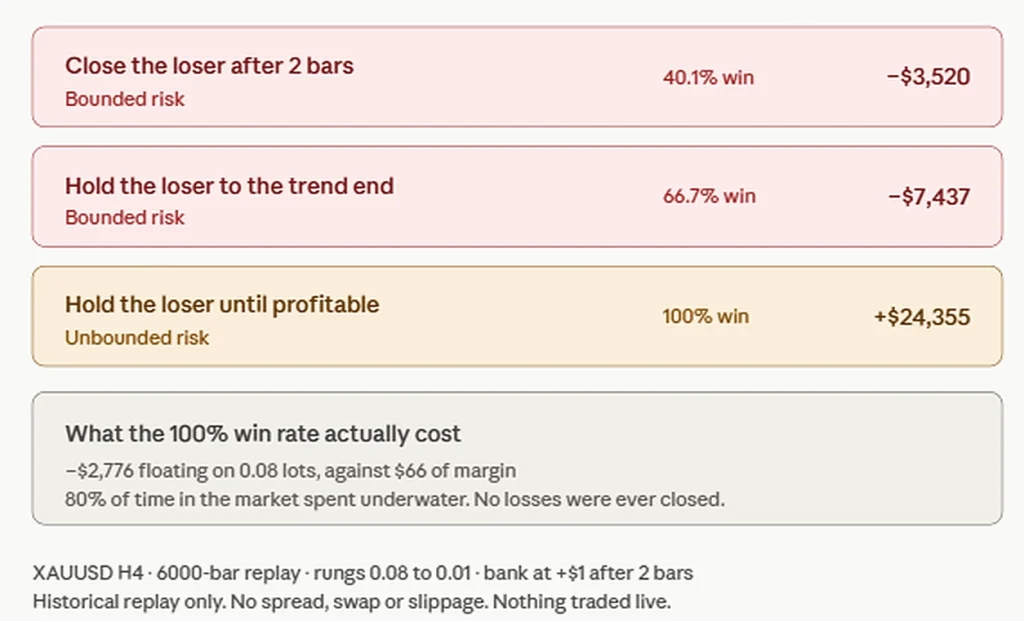
Three ways to handle a losing rung. The only profitable version is the one that never closes a loser — and it carried a $2,776
floating loss on a position needing $66 of margin. A 100% win rate is sometimes just a definition.
What the 100% win rate actually cost
The catch, in the tool’s own words: that 100% win rate floated −$2,776 underwater on just $66 of margin. It spent 80% of its time in the market underwater. And no losses were ever closed — they were simply held, hoping, until price eventually came back.
Now think about what that means on a real account. Floating −$2,776 against $66 of margin isn’t “a temporary dip” — that’s the kind of exposure that triggers a margin call and liquidates the whole account long before price ever returns. The 100% win rate only survives in a replay where the account has infinite money to hold through infinite pain. In the real world, the account dies during one of those underwater stretches, and the “100% win rate” is revealed for what it always was: a loss that hadn’t been counted yet.
This is exactly how martingale and grid systems blow up
I’ve written before about the accounts I’ve blown with grid and recovery systems — you can read the forensic post-mortem here. This replay is the same disease, isolated and shown clearly. Grid and martingale EAs advertise gorgeous, near-perfect win rates because they refuse to close losers — they add to them, average down, and wait. It works, and works, and works… until one trend doesn’t reverse, and the floating loss that was always there finally gets realised in the form of a blown account.
The seductive part is that it can work for months. Every day green. Every trade a winner. The account grows. And the whole time, the risk is accumulating invisibly in the open positions, uncounted, until the day it isn’t. I’ve lived this more than once. The screenshot looks amazing right up until the account hits zero.
The honest lesson: Why a 100% Win Rate Is the Most Dangerous Number in Trading
Here’s what this replay taught me, and it’s the single most valuable thing I can pass on:
- Win rate is almost meaningless on its own. Ask instead: what’s the worst floating drawdown, and are losses actually closed? A 40% win rate with bounded, closed losses is infinitely safer than a 100% win rate with unbounded floating ones.
- A closed loss is honest. A floating loss is a lie you tell yourself. The −$3,520 from cutting losers quickly is a real, survivable number. The “+$24,355 at 100%” hides a landmine.
- If a system never shows losing trades, that’s not a strength — it’s the warning sign. Real strategies take real losses. Be suspicious of perfection.
None of the three exit rules above is even “good” — the point isn’t which to use, it’s what the comparison reveals. The prettiest number on the board is the one that would ruin you. That’s the whole game, and it’s why I’ll always show you my drawdowns next to my wins.
Important: The figures here are from a historical replay with no spread, swap or slippage — a teaching illustration, not live results. Not financial advice. Trading and grid/martingale strategies carry a very high risk of total account loss. Past and simulated results do not predict future outcomes. These are my own results and opinions. Never trade money you can’t afford to lose.
Want to see this exact mechanic play out in real accounts?
- The forensic autopsy of the ladders that blew an account — where holding losers stopped being theory and cost real money.
- The two-second losing trade that exposed a one-line bug — the same “hidden loss” problem, found in code.
- What 3,456 trades taught me about grid depth — where this risk lesson reshaped how I think about grids.