I Built My Own Trading Scanner — Here’s Why (and What’s Still Broken)
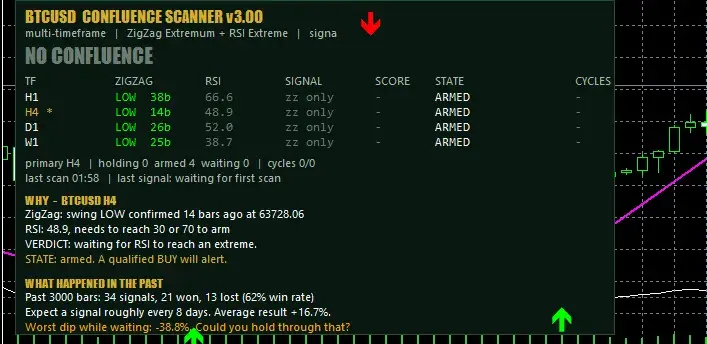
For years I relied on other people’s indicators to spot trading levels — ZigZag Extremum, RSI Extremum, a one-minute scalper signal. And for years the same frustrations wore me down: they repaint, they fire signals every few milliseconds, they can’t alert Telegram directly, and sending signals through workarounds got my messages broker-blocked for over-sending. So I did the only thing that actually fixes that: I built my own. This is an early look at my Confluence Scanner project — for gold, and for crypto — including what works, what’s still in testing, and how I plan to use it for my own altcoin holdings.
✅ Read this first: This is an early-stage project, not a finished product. Both the gold and crypto versions are still in active testing, and the direct Telegram alerts — the whole reason I started — are not fully working yet. I’m sharing the work in progress, honestly, warts and all. Nothing here is a signal service, a prediction, or a promise. It’s me building better tools and showing you the process.
Why I built my own scanner: four real frustrations
Every problem this project solves is one I lived with for years using off-the-shelf indicators:
- Repainting. The worst offender. An indicator shows a beautiful signal, you act on it, and then the candle closes and the signal moves or disappears — because it was drawing on unconfirmed price. A signal that changes after the fact is worse than useless; it’s actively misleading.
- Signal spam. Some of these fire alerts every few milliseconds — dozens or hundreds of “signals” an hour. When everything is a signal, nothing is. You either drown in noise or miss the one that mattered.
- No direct Telegram alerts. None of them could message Telegram directly, so I was forwarding email-to-Telegram through third-party apps — fragile, slow, and one more thing to break.
- Broker blocking. Because the signals came so often, my forwarding sometimes got throttled or blocked for over-sending. The tool meant to help was disrupting my whole workflow.
What the Confluence Scanner does differently
The core idea is in the name: instead of trusting one indicator, it only flags a level when two independent signals agree — confluence. Specifically, it looks for a ZigZag extremum and an RSI extreme zone lining up at the same level. One says “price has reached a structural turning point”; the other says “momentum is stretched.” When they agree, that’s a level worth my attention. When they don’t, silence.
- No repainting. It evaluates on confirmed, closed bars — so a signal that appears stays put. It won’t move on you after the fact.
- Confluence filtering kills the spam. Requiring two signals to agree naturally cuts the noise from hundreds of alerts down to the few that actually matter.
- Built for direct Telegram alerts. The goal is one clean alert straight to Telegram when confluence occurs — no email forwarding, no third-party glue. (Status: still in testing — more on that below.)
- A history replay harness so I can test how the scanner would have behaved on past data before trusting it live.
Honest testing status: early, and mixed
I won’t dress this up, because the whole point of this site is that I don’t. Here’s where the testing actually stands:
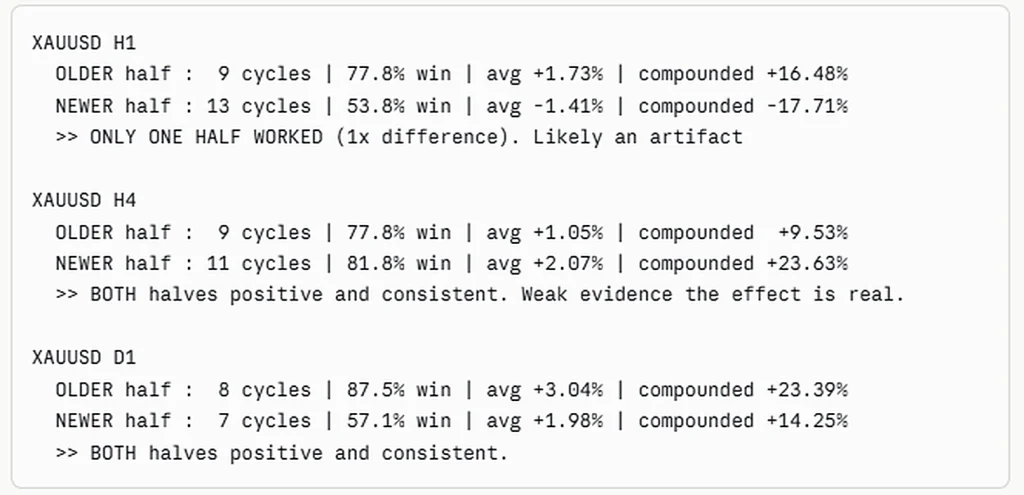
- Gold on the 4-hour timeframe is the most promising configuration so far — it’s the setup that has held up best across the split-sample tests I’ve run. That’s encouraging, but “best so far in limited testing” is a long way from “proven.”
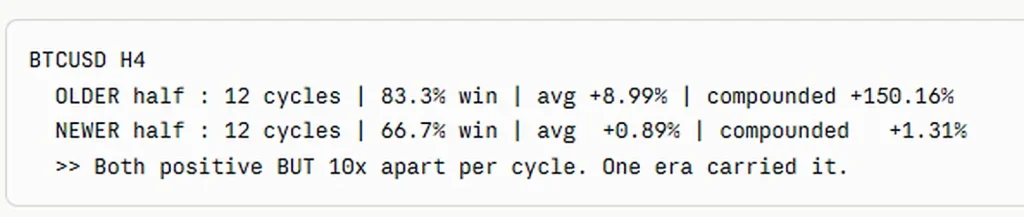
- The crypto version is earlier still. Some configurations looked good only because of one unusual period in the data — a warning sign I’ve learned to respect, not celebrate. More testing needed before I’d trust it.
- The Telegram alerts are not finished. This was the original motivation, and it’s still the piece I’m actively working on. I’d rather tell you it’s unfinished than pretend it works.
A lesson from my other testing: what a 100% win rate really costs
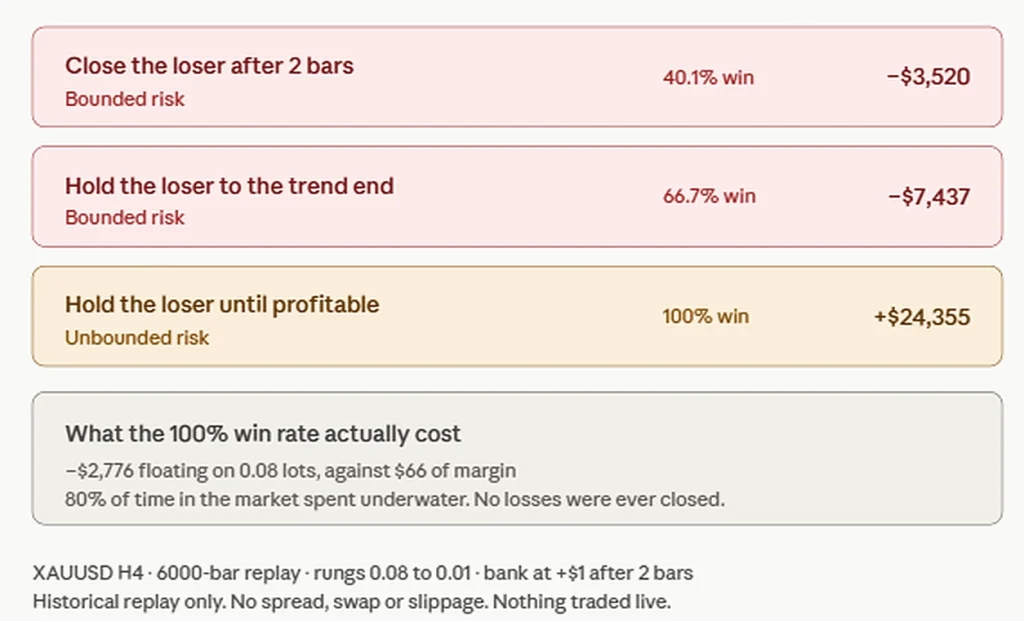
While building the scanner I also ran this replay, and it’s the most important risk lesson I have!
How I plan to use it for my own altcoins — honestly
Here’s the personal reason behind the crypto version, and I want to be careful how I put it. I’ve held altcoins for years, and my honest weakness has been emotional timing: I’ve bought too late, after everyone on YouTube is already shouting, near the highs — and I’ve failed to see retracements and crashes coming. The scanner isn’t a crystal ball for that, and I won’t pretend it is.
What a tool like this can and can’t do: It can flag when a coin reaches a level I decided was interesting in advance, calmly, without me refreshing charts in a panic. It cannot predict the bottom, guarantee I’ll catch a boost, or tell me an “altcoin season” is coming. In fact, the “altseason every four years” idea I used to wait for hasn’t reliably held up. The value isn’t prediction — it’s removing emotion and reacting to levels I set with a clear head, instead of buying because the internet is loud.
Right now BTC, ETH and many altcoins are trading at low levels. Does that mean a boost is coming? I genuinely don’t know, and anyone who tells you they do is guessing. What I can do is be prepared — define the levels that would interest me ahead of time, and let a tool watch for them, so if opportunities come I react to a plan rather than to hype.
Where I think this actually belongs: higher timeframes
Here’s an honest conclusion the testing pushed me toward. I ran most of my tests on the timeframes I’m used to for trading — but the more I look at the results, the more I think this kind of tool is naturally suited to higher timeframes than I tested: daily, even weekly. And that’s not me making excuses for underwhelming results — it’s about what the tool is fundamentally for.
The scanner’s whole job is spotting major structural turning points where price and momentum extremes agree. On a 4-hour chart, “extremes” happen often and many are just noise. On a weekly chart, a genuine ZigZag-and-RSI extreme is a rarer, more meaningful event — the kind that marks a real long-term high or low. Since my actual goal here is reading overall direction over the longer term — especially for deciding whether an altcoin is near a major bottom worth accumulating — the higher timeframes are where this logic should shine.
The honest caveat: I believe this, but I haven’t proven it yet — I haven’t run the full higher-timeframe tests. So treat it as a reasoned direction for the next phase of testing, not a claim. The next round of work is exactly this: does the confluence idea hold up on daily and weekly charts the way the logic suggests it should? I’ll report what I find, either way.
Honest verdict: a promising work in progress
I’m optimistic about this project, but optimism isn’t evidence. What I have is a scanner that fixes the real, specific problems that frustrated me for years — repainting, spam, no direct alerts — and early testing where gold H4 looks the most promising and crypto needs more work. I’ve also reached an honest conclusion about where it likely belongs: higher timeframes, for reading long-term direction, though I still have to prove that. The Telegram piece, the original reason I started, still isn’t done. So this is a genuine work in progress, shared at the messy middle stage rather than presented as a finished success.
I’ll keep testing, keep building the Telegram alerts, and post real results here as they come — including if a configuration I was hopeful about turns out not to work. Better tools won’t predict the market for me. But they might stop me making the emotional mistakes that have cost me the most.
Important: This describes a personal tool in development, not a signal service, product, or recommendation. Nothing here predicts market direction or advises buying or selling any asset, including cryptocurrencies. Trading and holding crypto carries a high risk of loss. Past and test results do not predict future outcomes. These are my own results and opinions. Never invest money you can’t afford to lose.
If you want to explore the risk side further:
- The 100% win rate that blows accounts — the full dissection of the “hold losers, show a perfect record” trap.
- The forensic autopsy of 10,328 grid trades — my rigorous side applied to a full EA.