Kill Your Darlings: Why I’m Retiring My Fibonacci Robots for Good
Saturday, 31 October 2026 · Day P&L: +$0 · Balance: $0
Today is the Day of the Dead, so it feels like the right day to hold a funeral. I’m burying my Fibonacci robots. Not pausing them, not “taking a break,” not promising a shiny new version next month. Dead and buried, for good. And here’s the strange part — this was one of my favourites. It worked. It made real money. And I’m killing it anyway. Let me tell you why that’s the smartest thing I’ve done all year.
✅ Read this first: This isn’t one of my “I made a mistake and didn’t notice” posts. There’s no hidden bug, no blown account, no disaster. This is me choosing to close something that still half-works, because half-works isn’t good enough anymore. That’s a different kind of honest — and honestly, a harder one.
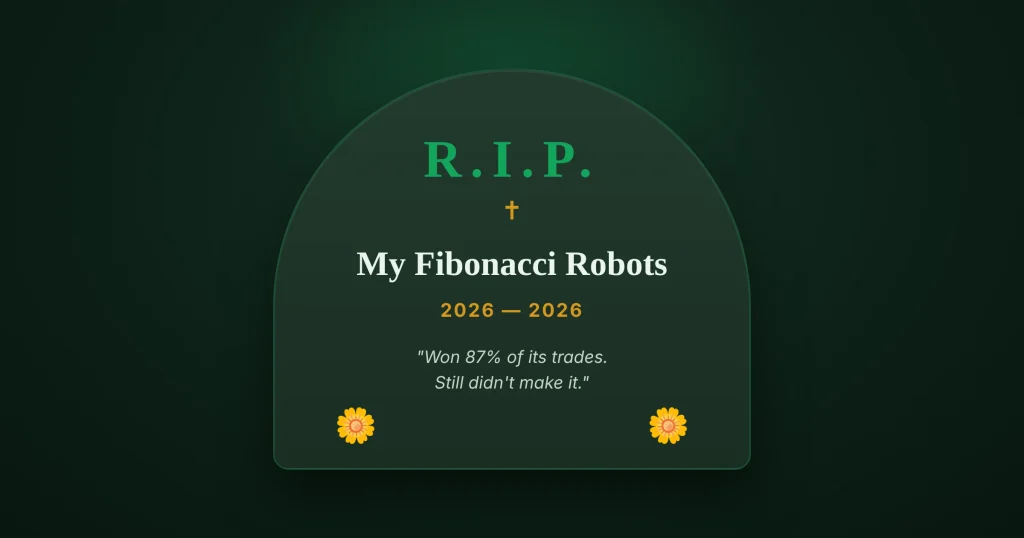
On the Day of the Dead, I gave my Fibonacci robots the send-off they earned.
“Kill your darlings” — the best advice I ever stole from design school
About twenty years ago I was studying web and design, and a teacher kept drumming one phrase into us: kill your darlings. The idea is simple and a bit brutal. The part of your work you love the most — the clever bit, the thing you’re proudest of — is usually the exact thing holding the whole project back. You fall in love with it, so you protect it, so you can’t see it clearly anymore. And the only fix is to cut it out. On purpose. Even though it hurts.
Writers do it with their favourite sentence. Designers do it with the logo they spent a week on. And it turns out traders need to do it too — with the robot they’re most attached to. That’s the one that quietly bleeds you, because you keep giving it one more chance it hasn’t earned.
My darling was Fibonacci — and I really did love it
Let me be straight: Fibonacci is powerful. I’ve seen it make hundreds of dollars a month, steady, like clockwork. When it’s in the right market and the timing lines up, it’s a thing of beauty. I’m not here to tell you Fibonacci is rubbish — that would be a lie, and you’d be right not to believe me.
But here’s the other side of that same coin. The exact same tool that quietly earns you hundreds over a month can empty the entire account in a few hours if the timing goes against you. I’ve watched it happen — I even went through the full breakdown of one of those blowups here. One bad stretch, one market that keeps running the wrong way, and the good month you were so pleased with is gone before dinner. That’s not a flaw you can patch out. That’s just what Fibonacci is: a sharp knife that cuts both ways.
That danger is the whole reason I stopped trusting other people’s Fibonacci signals and robots years ago. I’d see someone selling a Fib tool with lovely screenshots, and I knew — I knew — that under the hood it could blow the lot if you were unlucky with the timing. I didn’t want to hand my account to a black box like that. So I did what I always do when I don’t trust someone else’s tool: I decided to build my own.
So I built it myself. And built it again. And again.
I didn’t give Fibonacci one chance. I gave it a dozen. I tested it across different accounts and different brokers. I made version after version, tweaking small things each time — the spacing, the levels, the way it sized up. When I worried about the account-emptying risk, I even built separate protector robots whose only job was to sit on top and rescue the account if the Fib system got itself into trouble.
Think about that for a second. I was building a second robot to babysit the first one. That’s usually a sign — a loud one — that the first robot isn’t really pulling its weight. If you need a bodyguard following your business partner around in case they rob you, maybe they’re not a great business partner.
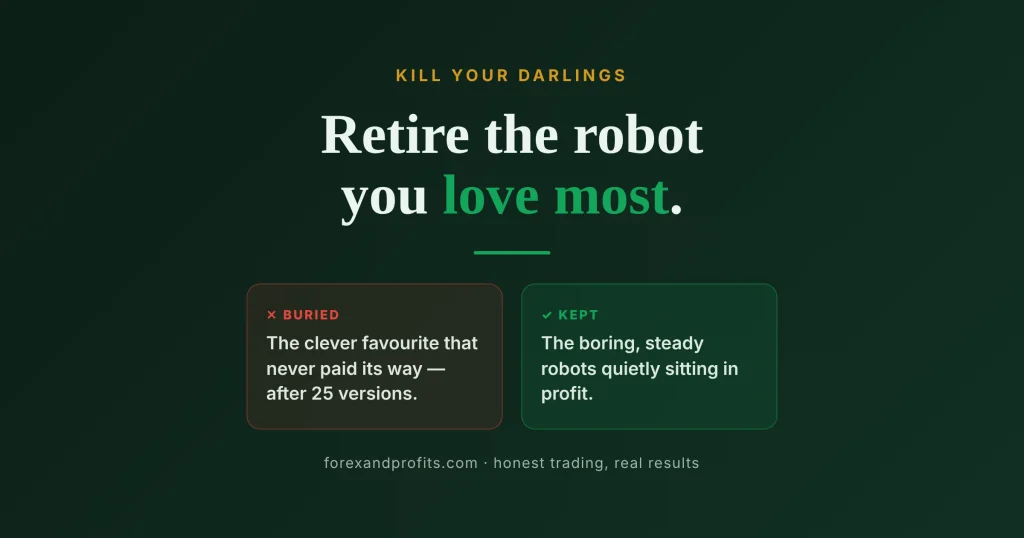
The hardest cut isn’t the obvious loser — it’s the clever favourite you’re attached to. Bury that one, and give the boring winners your attention instead.
The honest moment: it’s had its chances
Here’s the number that settled it for me. After all those versions, all those accounts, all that babysitting — my Fibonacci robots are not in positive net. Months of work, and when I add it all up, the Fib system hasn’t put me ahead. (If you want the full numbers, I broke down all 10,132 trades here — I won 87% of them and still lost money, and that story alone is worth a read.)
Meanwhile, I’ve got other robots that have quietly been sitting in positive net for several months now. Not exciting ones. Not my favourites. Just steady, well-behaved ones doing their job. (More about those in another post — they’ve earned their own write-up.)
And that’s the trap, right there. I was spending my best hours fighting to save my favourite robot — the one that wasn’t making money — while my boring robots, the ones actually in profit, got less of my attention. I had it exactly backwards. I was pouring time into the darling and taking the quiet winners for granted.
Today, I’m pulling the plug — for good
So this is it. No “Fibonacci v9.” No “one more small change.” No new protector bolted on top. I’m closing the whole Fib system down and retiring it.
⚰️ Officially retired: I will not improve or make new versions of the Fibonacci EA. This is complete closing and full retirement of that system. It had real strengths, it had its chances across many versions, and it hasn’t earned a place in the fleet. Rest in peace. 🤍
Why this is a win, not a loss
It would be easy to read this and think I failed. I don’t see it that way, and I don’t think you should either. Retiring a robot that isn’t working isn’t failure — it’s focus. Every hour I spent keeping Fibonacci on life support was an hour I wasn’t spending on the systems that are actually making money. Killing the darling frees up all that time and attention for the robots that deserve it.
If there’s one thing I’d want you to take from this, it’s this: be willing to kill the thing you love most. Not the obvious losers — those are easy to drop. The dangerous one is your favourite, the clever one, the one you’re emotionally invested in. That’s the darling. And if it isn’t paying its way after a fair run, honesty means burying it, not nursing it for another six months out of pride.
Count up where your time really goes. Then ask yourself, honestly: am I keeping this because it works, or because I love it? For me, with Fibonacci, I finally knew the answer. So on the Day of the Dead, I’m giving it the send-off it deserves — and getting back to the robots that are actually alive.
Important: Nothing here is financial advice. Fibonacci, grid and similar strategies carry a very high risk of large or total loss — exactly the account-emptying risk described above. My results are my own, from my own accounts, and past results never predict future ones. Never trade money you can’t afford to lose.