Saturday, 31 October 2026 · Day P&L: +$0 · Balance: $0
I won 87 out of every 100 trades. Nearly nine wins for every loss. And I still lost money — about $2,300 of it, over four months and 10,132 trades. If that sounds impossible, good. It’s the single most important thing I’ve learned building trading robots, and it’s the real reason I buried my Fibonacci robots for good. Here’s the full story, numbers and all.
✅ Read this first: All of this is from demo accounts — no real money was lost. 2 July to 31 October 2026, across gold, Bitcoin, GBPUSD and EURUSD. This is the hard-numbers companion to my retirement post: that one was the decision, this one is the proof. If you only take one lesson from the whole site, take this one.
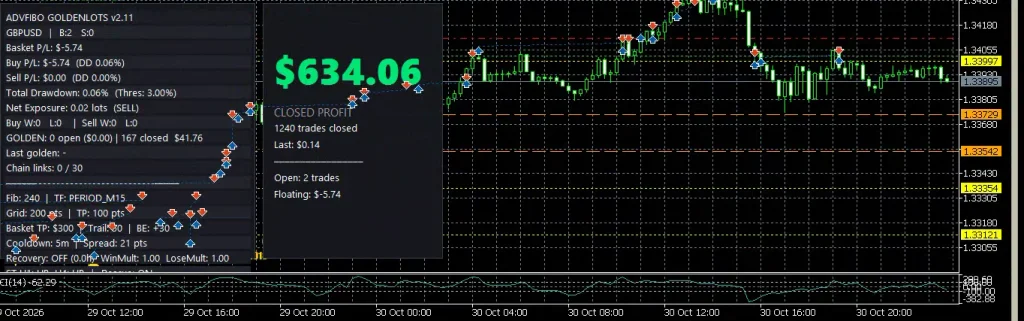
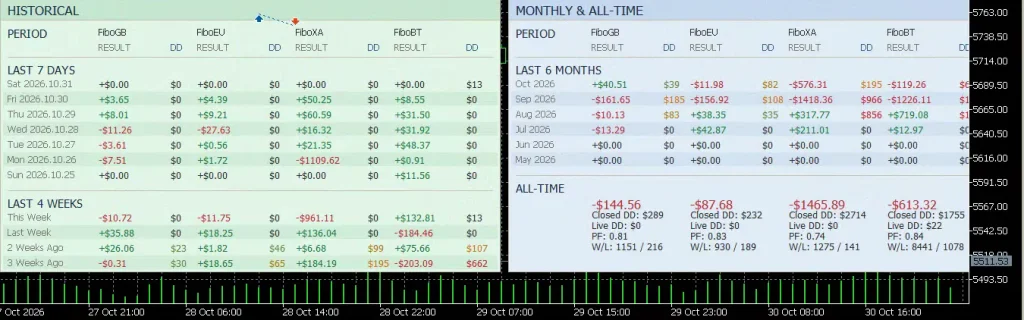
Live dashboard from the AdvFibo GoldenLots v2.11 grid EA on GBPUSD M15, demo account. It shows 1,240 closed trades and $634 closed profit on the panel, while the per-magic Performance Dashboard shows −$144.56 all-time.
The number that explains everything: small wins, big losses
Here’s the trap, and it’s a sneaky one. My robot won nearly all the time — but each win was tiny, and each loss was huge. On average, one loss wiped out six to ten wins. So winning 87% of the time wasn’t nearly enough. To just break even, it needed to win 85–91%. It won 83–89%. That gap is the whole story.
Chart
Win rate
Win rate needed just to break even
Average win
Average loss
Gold
89%
91%
$3.34
−$35.81
Bitcoin
88%
90%
$0.44
−$3.82
GBPUSD
84%
87%
$0.57
−$3.69
EURUSD
83%
85%
$0.47
−$2.77
Look at the average win versus the average loss on gold: $3.34 against −$35.81. One bad trade ate ten good ones. You can win almost every hand and still leave the table broke.
This is the thing the win-rate screenshots never tell you. A seller shows you “90% win rate!” and your brain fills in “so it must make money.” It doesn’t. A high win rate on its own means nothing. What matters is how big the wins are next to the losses — and mine were tiny wins against monster losses.
Why the wins were so small
Only about a quarter of my winning trades ever reached their full target. The rest got closed for pennies by breakeven and trailing stops — safety features I’d added to protect the account. So the wins were deliberately shrunk down to protect them, while the losses were left free to grow. Good intentions, backwards result.
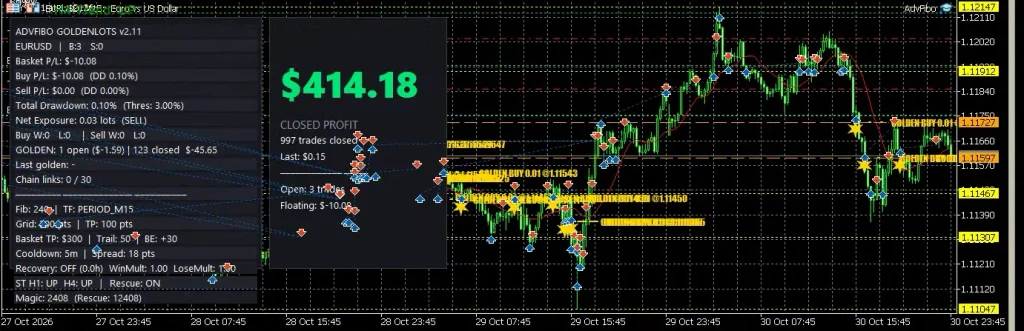
The gold stars mark “golden zone” trades at the 50% and 61.8% Fibonacci levels.
The month that took it all back: September
July and August looked great. If I’d written this post at the end of August, I’d have been bragging. Then September showed up and took the lot — and then some.
Month
Result
July
+$154
August
+$845
September
−$2,902
October (to the 21st)
+$280
September alone lost more than July, August and October earned put together. Three good months, one bad one, and the bad one won.
One single week in September lost −$2,588 — twice as much as the ten good weeks before it had made between them. My best day ever was +$301. My worst day was −$1,640. That’s more than five good days undone in one bad one. See the pattern? It’s the same disease at every scale: the downside was always much bigger than the upside.
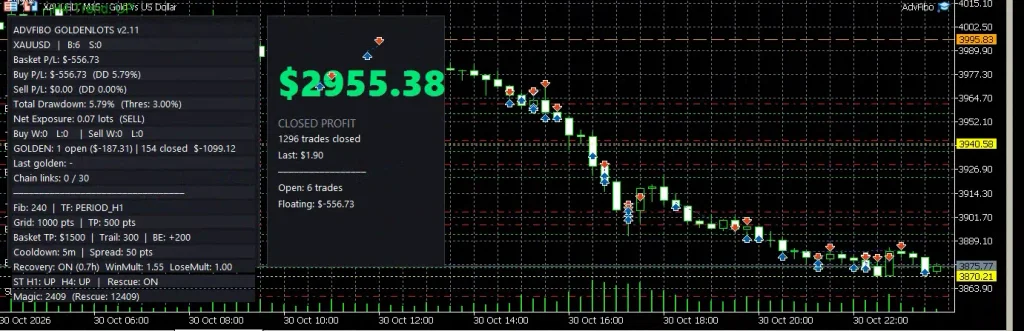
Six buys open while gold kept falling. This is how the big losses started.
2% of the trades did all the damage
This one genuinely surprised me. Out of 10,132 trades, the worst 202 — just 2% — lost −$8,289 between them. The other 9,930 trades made +$6,666. So the robot was profitable 98% of the time and still lost overall, because that tiny slice of disasters was bigger than everything else added together.
Here’s the uncomfortable truth: a robot like this spends 98% of its life looking brilliant. That’s exactly why it’s dangerous. You watch it win day after day, you start to trust it, maybe you put more money behind it — and then the 2% arrives and takes it all. The good behaviour isn’t proof it’s safe. It’s the bait.
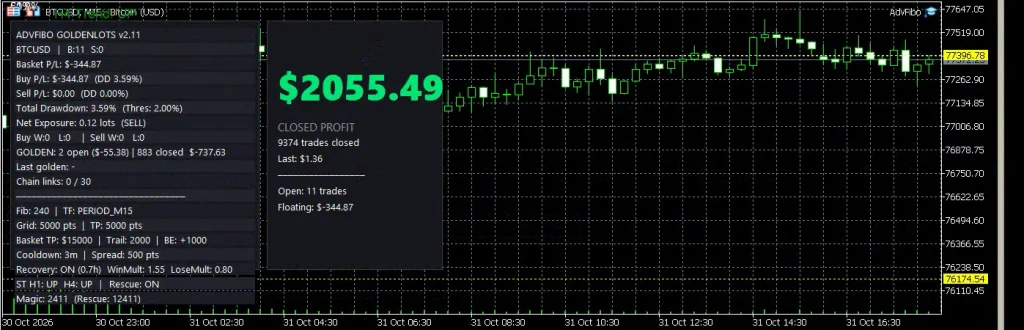
Over 9,000 Bitcoin trades, mostly small wins, and still in the red.
It was secretly a one-way bet
Two more things the numbers gave away. First: 97% of all my trades were buys. In plain terms, the robot only really knew how to make money when prices were going up. When they fell, it just handed the money back.
Second: all four of my charts were really the same bet in disguise. Gold, Bitcoin, GBPUSD and EURUSD tend to fall together whenever the US dollar gets strong. I thought I was spread across four different markets. I wasn’t — I was four times into one. So in September, when the dollar ran, all four lost at the same time. No safety in that “diversification” at all.
I tried everything. None of it worked.
I don’t want anyone thinking I gave up after one bad month. Over those four months I built around 25 versions across two robot families. I added a trend filter so it would stop buying into falling markets. I capped the lot sizes so one trade couldn’t balloon. I built separate protector robots whose only job was to step in and close a bad run before it got ugly. I even ran two-year tests in the simulator.
The protectors did help — they stopped the worst blow-ups. But here’s the hard lesson: a protector can stop a disaster, but it can’t turn a losing strategy into a winning one. I also checked whether just trading smaller would fix it. It didn’t — three of the four charts still lost money even at the tiniest possible lot size. The problem was never the size of the bets. It was the strategy underneath them.
Every AdvFibo magic number (2407, 2408, 2409, 2411) ended below zero.
What I’m taking into the next robot
Four months, 10,132 trades and about $2,300 gone on demo — but not for nothing. This is what it bought me, and it’s what I’ll be checking in every robot from here on:
A high win rate means nothing on its own. If one loss can wipe out ten wins, winning 90% of the time still loses. Always check the size of the wins against the size of the losses.
Don’t let wins get shrunk while losses run free. If your “safety” closes winners for pennies but lets losers grow, it’s not safety — it’s a slow leak.
Trade both directions, or pick markets that don’t all move together. Four charts that fall at the same time aren’t four bets. They’re one.
Cap the bet size in real money from day one. The biggest single losses all came from positions that grew too large.
Judge a robot over three or four months, not two or three good weeks. July and August lied to me. September told the truth.
A protector buys time, not profit. If the strategy underneath loses, no bodyguard will save it.
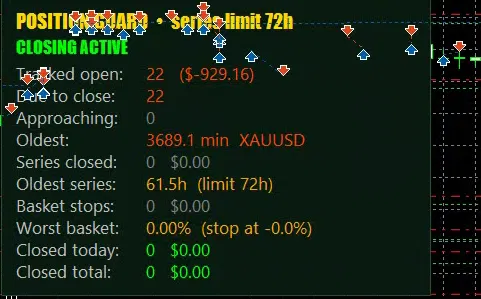
PositionGuard, the protector we built to close trades stuck for days.
That’s why the Fibonacci robots are retired — not because they blew up in a fireball, but because four months of real numbers said, quietly and clearly, that they don’t pay their way. I’d rather learn that on demo and move on than find it out with real money. Next up, I’ll show you the robots that are sitting in the green — the boring, well-behaved ones that earned the attention I was wasting on this.
Important: All results are from demo accounts, not live trading. Demo results routinely fail to survive real spreads and slippage. Grid, martingale and Fibonacci-style strategies carry a very high risk of large or total loss. Nothing here is financial advice. These are my own results and opinions. Never trade money you can’t afford to lose.